Weld Consultancy and Inspection
Introduction
It is not always feasible for a company to employ a full time welding specialist or consultant, dedicated to remaining up to date with current welding standards.
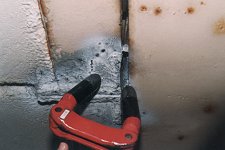
Magnetic Particle Inspection of a weld
We offer a service to meet this requirement which can include interpretation of specifications, documentation reveiw and specialist advice concerning welding problems.
Inspection
Welding inspection can be carried out at the fabrication stage or on site. All of our personnel are qualified to nationally recognised certification schemes for each of the following NDT methods: Visual, Magnetic Particle (MPI), Dye Penetrant, Ultrasonic.
Qualification tests
We can offer a complete service from witnessing test plates being welded, carrying out and recording non-destructive and mechanical tests in the laboratory to interpreting the data and compiling the qualification certificates.
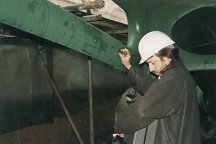
Ultrasonic thickness measurement
BS EN 288 and BS EN 287
BS EN 288 specifies how a welding procedure is approved by a procedure test. BS EN 287 covers the principles to be observed in the approval testing of welder performance.
Laboratory testing
The following destructive and non-destructive testing is carried out under UKAS accreditation:
| Destructive | Non-destructive |
|
Macro testing
Hardness Testing
Impact Testing
Fracture Tests
Tensile Testing
Chemical Testing
|
Visual Inspection
Magnetic Particle Inspection
Dye Penetrant Inspection
Ultrasonic Inspection
|
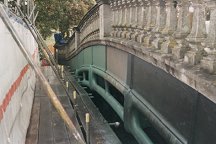
Inspection of a cast-iron bridge
Investigation and Testing
Existing structures
We can provide specialist engineers to investigate and survey any damage or failures (and potential failures) of structures and identify and record the cause and extent of the damage. This information can then be analysed to prevent future recurrence if applicable.
If it is possible to repair the structure, a repair/welding procedure will be developed, recommending an approved course of action in accordance with your requirements and the relevant specifications.
Identification and Weldability
Samples taken on site can be analysed to identify the basic elements and, hence, the type and quality of the steelwork.
This information is then used to calculate the carbon equivalent and assess weldability.
This is particularly useful in the appraisal of historic cast-iron and wrought iron structures
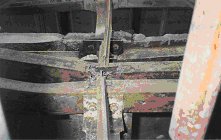
Investigation of fire-damaged structures
New structures
Advice and information can be given on the setting of quality levels before work commences. |